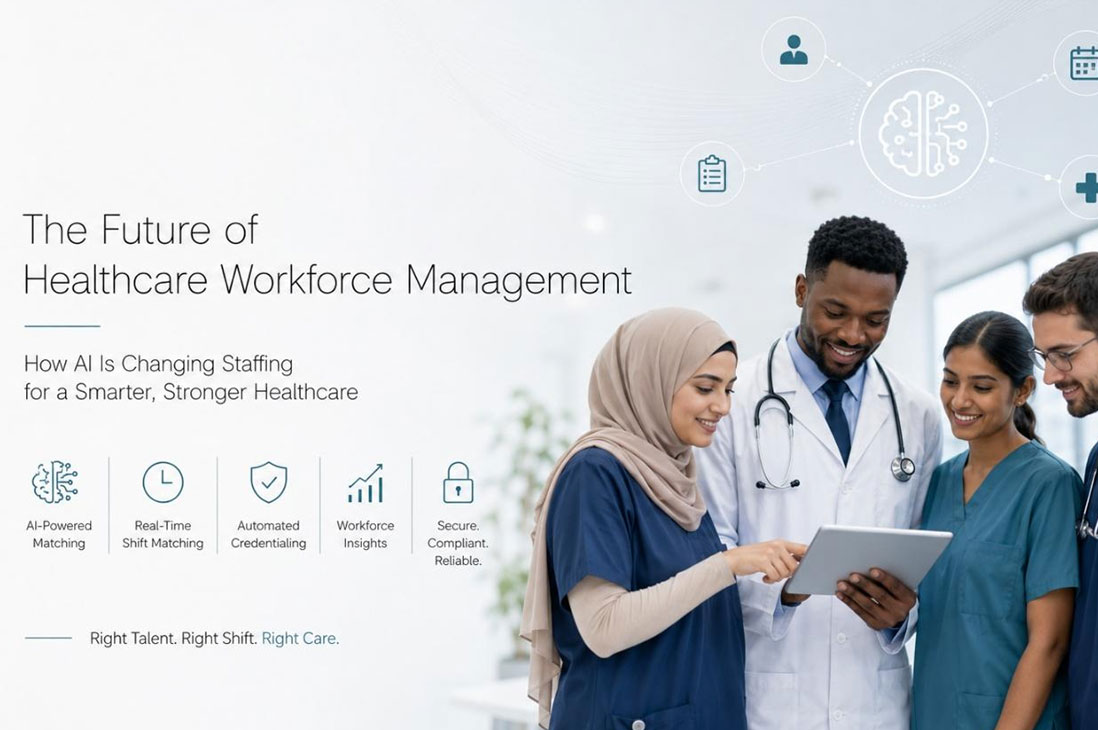
The Future of Healthcare Workforce Management: How AI Is Changing Staffing
Introduction
Healthcare is entering a new era of workforce management.
Hospitals, clinics, health systems, and other care providers are under growing pressure to deliver highquality patient care while managing staff shortages, rising operational costs, unpredictable demand, and increasing administrative workloads. Traditional staffing methods, which often depend on manual scheduling, recruiter communication, spreadsheets, and disconnected systems, are becoming increasingly difficult to scale.
The challenge is not simply finding more healthcare professionals. It is about connecting the right healthcare professional with the right shift at the right time while maintaining compliance, transparency, and operational efficiency.
This is where Artificial Intelligence (AI) is changing the healthcare workforce landscape.
AIpowered workforce management can analyze availability, qualifications, specialty, location, demand, and staffing requirements to make faster and more informed workforce decisions. Instead of relying entirely on manual processes, healthcare organizations can use intelligent systems to automate matching, streamline credential verification, predict staffing requirements, and reduce administrative workloads.
Platforms such as NAYX represent this emerging model of healthcare workforce management by connecting healthcare facilities directly with verified clinical professionals through AIpowered matching and automated workforce coordination.
Why Healthcare Workforce Management Needs a New Approach
Healthcare staffing has always been complex.
A hospital may suddenly need additional nurses because of an increase in patient admissions. A clinic may require a physician to cover an unexpected absence. A rural healthcare facility may struggle to find specialized professionals locally. A health system may need temporary staff during seasonal demand or a workforce shortage.
Traditional staffing processes can make these situations even more difficult.
Recruiters may need to contact multiple professionals, verify credentials, confirm availability, negotiate rates, coordinate schedules, and complete administrative paperwork before a shift is filled.
This creates several challenges:
- Slow shift fulfillment
- High administrative workload
- Staffing agency markups
- Limited visibility into workforce availability
- Manual credential verification
- Difficulty responding to sudden changes in patient demand
- Communication delays between facilities and professionals
- Increased pressure on existing healthcare teams
The scale of the workforce challenge makes innovation increasingly important. The World Health Organization projects a global health workforce shortage of approximately 11 million workers by 2030.
As healthcare demand continues to evolve, organizations need workforce systems that can respond faster and operate more intelligently.
How AI Is Changing Healthcare Staffing
AI is moving workforce management from a reactive process to a more proactive and datadriven model.
Instead of waiting for a vacancy to become an operational problem, AI systems can continuously analyze workforce data and help organizations anticipate staffing requirements.

1. Intelligent Staff Matching
One of the most important applications of AI in healthcare workforce management is intelligent matching.
AI can evaluate multiple variables simultaneously, including:
- Professional credentials
- Clinical specialty
- Location
- Availability
- Shift requirements
- Experience
- Facility requirements
- Compensation preferences
NAYX uses AIpowered matching to connect open healthcare shifts with qualified, preverified professionals in real time. Its platform is designed to match credentials, specialty, location, and availability when connecting clinical talent with open shifts.
This can significantly reduce the time organizations spend searching for suitable professionals.
2. Faster Shift Fulfillment
A vacant clinical shift can create pressure across an entire healthcare organization.
When a position remains unfilled, existing employees may need to work additional hours, managers may have to make lastminute scheduling adjustments, and patient services can become more difficult to manage.
AI can accelerate the staffing process by automatically identifying professionals who meet the requirements of an open shift.
NAYX's workforce model allows facilities to post shift requirements directly, after which its AI matching process connects the opportunity with suitable clinical professionals. The platform also supports automated onboarding and digital shift acceptance.
The result is a staffing process designed around speed, availability, and relevance rather than manual backandforth communication.
3. Predictive Workforce Planning
AI's role in healthcare staffing goes beyond filling existing vacancies.
Predictive analytics can help organizations understand future workforce requirements by analyzing historical and realtime data.
For example, AI can identify patterns related to:
- Patient volumes
- Seasonal demand
- Staff availability
- Absenteeism
- Shift utilization
- Department workload
- Historical staffing requirements
This allows workforce managers to move from:
"We have a staffing shortage today."
to:
"Our data indicates that we may need additional staff next week."
That shift from reactive staffing to predictive workforce planning can help healthcare organizations prepare earlier and allocate resources more effectively.
Recent research into AIdriven hospital human resource management has highlighted applications involving workforce planning, scheduling, and performance evaluation, particularly where traditional manual approaches struggle to adapt to changing requirements.
4. Automated Credential Verification
Healthcare staffing cannot rely on availability alone.
A professional must have the appropriate qualifications, licenses, certifications, and background checks for the role they are being considered for.
Manual verification can be timeconsuming, especially for organizations managing large contingent workforces.
AIenabled workforce platforms can help automate parts of this process by organizing professional credentials and identifying whether a candidate meets predefined requirements.
NAYX states that its platform performs automated credentialing, state license verification, and background checks before professionals are matched with facilities. Facility administrators can review verified credentials and work history through the platform.
This creates a more structured approach to workforce compliance while reducing repetitive administrative tasks.
5. Reducing Administrative Burden
Healthcare professionals spend significant time on documentation and other administrative responsibilities.
While documentation is essential for safe and compliant care, excessive administrative work can reduce the amount of time clinicians have available for patientfacing activities.
AI can help by automating repetitive documentation and informationmanagement tasks.
NAYX, for example, includes an offline AI documentation capability that generates structured SOAP notes locally on the clinician's device. According to the platform, clinicians can review and edit AIgenerated notes before exporting them to their EHR system.
This reflects a broader direction in healthcare AI: using technology to augment professionals rather than simply replace them.
Recent commentary in The Lancet similarly argues that healthcare AI can function as a workforcesupport and retention tool by reducing administrative workloads and allowing clinicians to focus more time on care, teaching, and leadership.
6. Greater Transparency in Healthcare Staffing
Traditional staffing models can involve multiple intermediaries.
For healthcare facilities, this may mean additional costs and less direct visibility into staffing rates and professional availability.
AIenabled workforce platforms are creating opportunities for more direct connections between healthcare organizations and professionals.
NAYX's model is designed to connect facilities directly with verified clinical talent while providing transparent rates and eliminating hidden staffing agency fees.
Greater transparency can benefit both sides:
For healthcare facilities:
- Better visibility into staffing costs
- Faster access to professionals
- Reduced dependency on intermediaries
- Centralized workforce management
For healthcare professionals:
- More visibility into available shifts
- Greater scheduling flexibility
- Direct access to opportunities
- Transparent compensation
7. AIPowered Workforce Management for Different Care Settings
Healthcare organizations do not have identical staffing requirements.
A large hospital may need to manage hundreds or thousands of professionals across multiple departments. A private clinic may need occasional parttime coverage. A rural healthcare center may struggle to access specialized professionals.
AIPowered workforce platforms can adapt to different staffing environments.
Hospitals and Health Systems
Large healthcare organizations can use intelligent workforce tools to coordinate contingent staffing, manage demand fluctuations, and gain greater visibility into workforce coverage.
Private Clinics
Clinics can use AIassisted matching to find qualified professionals for parttime, weekend, or urgent staffing requirements.
Rural Healthcare
AI can help connect geographically separated healthcare facilities with professionals willing to travel or provide appropriate services remotely.
Specialty Healthcare
Organizations requiring specialized clinical expertise can use intelligent matching to identify professionals with the appropriate qualifications and experience.
Telehealth
AIenabled workforce platforms can also support the scaling of virtual care teams by connecting digital healthcare providers with suitable clinical professionals.
NAYX specifically identifies hospitals, private clinics, solo practitioners, rural and community healthcare, specialists, and telehealth providers among the settings its platform supports.
AI Will Not Replace Healthcare Professionals It Will Change How They Work
One of the biggest questions surrounding AI in healthcare is whether automation will replace human workers.
The more practical future is likely to be different.
AI is particularly valuable when it handles repetitive, administrative, and dataintensive processes while humans remain responsible for professional judgment, patient relationships, clinical decisions, and complex problemsolving.
Cognita Cybernetics similarly describes its healthcare AI approach as AI augmentation rather than worker replacement, emphasizing the use of AI to automate repetitive tasks and provide healthcare professionals with better datadriven insights.
The future healthcare workforce is therefore likely to become a combination of:
Human expertise | AI intelligence | automated workflows.
This model allows professionals to spend less time navigating administrative processes and more time applying their expertise where it matters most.
The Importance of Privacy and Compliance
Healthcare workforce technology operates within an environment where sensitive information must be carefully protected.
Any AI system used in healthcare needs to consider:
- Data privacy
- Security
- Access control
- Auditability
- Regulatory requirements
- Credential verification
- Responsible AI practices
NAYX highlights secure, privacyfocused workforce management and states that its AI documentation feature processes audio and notes locally on the clinician's device rather than sending them to the cloud.
This type of privacyconscious architecture can become increasingly important as healthcare organizations adopt AI across staffing, documentation, operations, and patientcare workflows.
What the Future of Healthcare Staffing Could Look Like
The healthcare workforce of the future will likely be increasingly dynamic.
Instead of relying exclusively on fixed staffing structures, organizations may be able to build flexible workforce ecosystems that combine permanent employees, locum professionals, specialists, contingent workers, and virtual clinicians.
AI can act as the intelligence layer connecting these resources.
A future workforce platform could continuously:
- Monitor workforce availability.
- Analyze patient and operational demand.
- Identify potential staffing gaps.
- Recommend the required workforce mix.
- Match qualified professionals.
- Verify credentials and compliance.
- Automate onboarding.
- Track staffing performance.
- Analyze workforce trends.
- Improve future staffing decisions using historical data.
This creates a continuous workforce management cycle rather than a series of disconnected staffing activities.
The Next Step: From Workforce Management to Workforce Intelligence
The biggest opportunity may not simply be automating recruitment.
It is creating workforce intelligence.
Healthcare organizations generate enormous amounts of operational data. When AI can analyze that information in real time, workforce managers can make better decisions about where, when, and how people are deployed.
Instead of simply asking:
"Who is available?"
organizations can begin asking:
"Who is the best fit for this requirement, when will we need them, and how can we optimize our workforce before a shortage occurs?"
That is the transition from traditional workforce management to intelligent workforce management.
How NAYX Fits Into the Future
NAYX is built around this shift.
Its platform combines AIpowered workforce matching, direct facilitytoprofessional connections, automated credentialing, transparent staffing, workforce analytics, and AIassisted documentation into a healthcare workforce ecosystem.
For healthcare organizations, this means a more connected approach to finding and managing clinical talent.
For healthcare professionals, it means greater control over when, where, and how they work.
And for the healthcare industry as a whole, it points toward a future where workforce decisions can be faster, more transparent, more flexible, and increasingly datadriven.
The future of healthcare workforce management is not simply about hiring more people.
It is about using technology to make every healthcare professional more accessible, every staffing decision more informed, and every workforce more responsive to patient needs.
AI is already changing how organizations approach scheduling, matching, credentialing, documentation, and workforce planning. As the healthcare industry continues to face workforce shortages and rising demand, intelligent automation will become an increasingly important part of the solution.
The winning healthcare organizations will not necessarily be those that automate everything.
They will be the ones that understand where AI can create the greatest operational value while keeping human expertise at the center of healthcare delivery.
With platforms such as NAYX connecting verified healthcare professionals with facilities through intelligent, realtime workforce technology, the future of staffing is moving toward a model that is faster, more flexible, transparent, and humancentered.
The future of healthcare staffing is intelligent. And it is already taking shape.